Real change doesn’t start with behaviour charts.
It starts with environments.
If you work in learning disability or autism support, you already know this intuitively: people thrive when their surroundings, relationships, routines, and support systems genuinely meet their needs.
Yet too often, we focus on individual behaviour without fully examining the wider context shaping it.
That’s where Capable Environments come in.
What Do We Mean by “Capable Environments”?
A Capable Environment is one that actively supports:
- Wellbeing
- Choice and autonomy
- Meaningful activity
- Positive relationships
- Communication
- Physical and emotional safety
- Skilled, reflective support
Rather than asking:
“How do we manage this behaviour?”
Capable Environments invite us to ask:
“What needs to change around this person so they can thrive?”
It’s a shift from fixing people to designing environments that work.
This approach recognises that behaviour is shaped by many interacting factors — physical spaces, staff practices, organisational culture, predictability, opportunities for connection, and access to meaningful lives.
When these align, we see:
- Reduced distress
- Increased engagement
- Stronger relationships
- Greater independence
- Improved quality of life
- More confident, supported staff
Capable Environments aren’t an “add-on”.
They are the foundation of good support.
The 12 Domains of Capable Environments
Over the next 12 weeks, we’ll explore each domain in detail. Together, they form a whole-system framework:
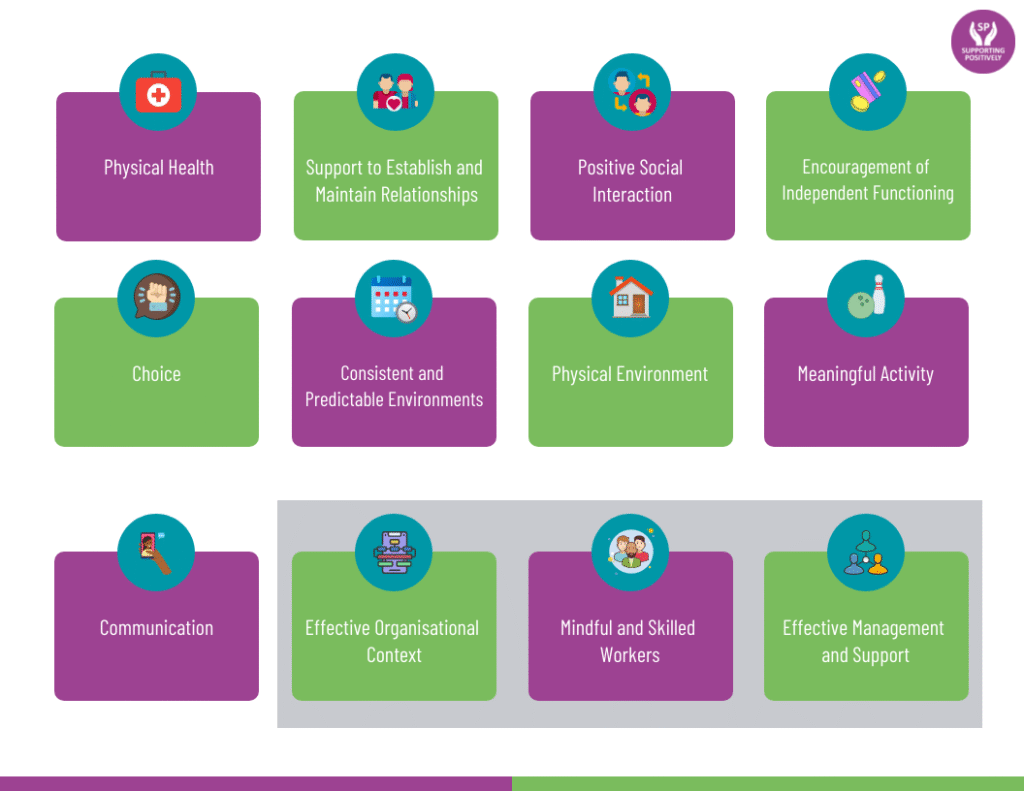
Each domain matters on its own but real impact happens when they work together.
Think of them as interlocking pieces rather than separate initiatives.
Why Capable Environments Matter in Everyday Practice
Let’s bring this down to ground level.
Imagine two services:
Environment A
- Staff are rushed and reactive
- Routines change daily
- Limited opportunities for choice
- Activities are mostly time-filling
- Communication approaches vary by staff member
Environment B
- Predictable routines support emotional safety
- Staff use consistent communication
- People are supported to make everyday choices
- Activities reflect personal interests
- Relationships are actively nurtured
- Leaders model reflective practice
Which environment is more likely to support wellbeing?
Which one reduces distress before it escalates?
Capable Environments help us move from firefighting to prevention: from managing crises to building lives.

A Practical Starting Point: Reflect on Your Own Environment
Before diving into individual domains, it’s helpful to step back and look at the whole picture.
Ask yourself:
- Where are we already strong?
- What feels hardest right now?
- Which areas might be quietly undermining wellbeing?
Small changes, thoughtfully applied, often create powerful ripple effects.
Free Resource: Capable Environments Self-Reflection Tool
To support this first step, we’ve created a simple Capable Environments Self-Reflection Tool.
You can use it with:
- Individual staff
- Teams
- Supervisors
- Service managers
How it works:
Rate your current environment across all 12 domains, then identify:
- One area of strength to build on
- One priority area for improvement
It’s not about perfection, it’s about clarity and direction.
Join the Capable Environments Training Series
If you’d like structured, practical support to embed Capable Environments in real services, our monthly training series explores each domain in depth.
You’ll gain:
- Practical tools you can use immediately
- Real-world examples
- Space for reflection
- Clear links between theory and everyday practice
Book your place on the Capable Environments Training Series
Bookings are open via Eventbrite.

As an added benefit, every session in the Capable Environments training series provides 1 APD, so you’re supporting both your practice and your professional development at the same time.