
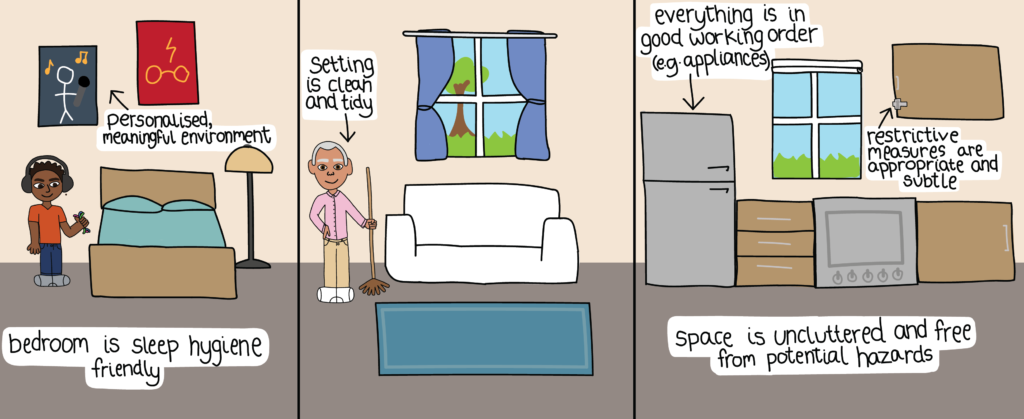
“The environments we create influence how people feel, what they can do, and who they can become.”
When we think about improving services, it’s easy to focus on training staff, reviewing policies or introducing new systems. Yet one of the most powerful influences on quality of life is often the thing we stop noticing because we see it every day; the physical environment.
The spaces in which people live, learn and work shape their experiences. They can either encourage independence, promote relationships, reduce stress and create opportunities, or they can unintentionally limit choice, increase frustration and reinforce dependence.
A capable environment doesn’t happen by accident. It is intentionally designed to help people thrive.
Looking Beyond the Building
When people hear the words physical environment, they often think about decorating, maintenance or whether a building meets regulatory standards.
These things matter, but capable environments ask a much bigger question:
“Does this environment help people live the life they want?”
The physical environment includes everything from lighting, noise levels and accessibility to how furniture is arranged, whether people can easily access the things that matter to them, and whether the space feels like a home rather than a service.
A beautiful building does not automatically create a good quality of life. Equally, a modest environment can become an exceptional place to live when it is designed around the person.
The Environment Changes Behaviour
“The environments we create influence how people feel, what they can do, and who they can become.”
When we think about improving services, it’s easy to focus on training staff, reviewing policies or introducing new systems. Yet one of the most powerful influences on quality of life is often the thing we stop noticing because we see it every day; the physical environment.
The spaces in which people live, learn and work shape their experiences. They can either encourage independence, promote relationships, reduce stress and create opportunities, or they can unintentionally limit choice, increase frustration and reinforce dependence.
A capable environment doesn’t happen by accident. It is intentionally designed to help people thrive.
Looking Beyond the Building
When people hear the words physical environment, they often think about decorating, maintenance or whether a building meets regulatory standards.
These things matter, but capable environments ask a much bigger question:
“Does this environment help people live the life they want?”
The physical environment includes everything from lighting, noise levels and accessibility to how furniture is arranged, whether people can easily access the things that matter to them, and whether the space feels like a home rather than a service.
A beautiful building does not automatically create a good quality of life. Equally, a modest environment can become an exceptional place to live when it is designed around the person.
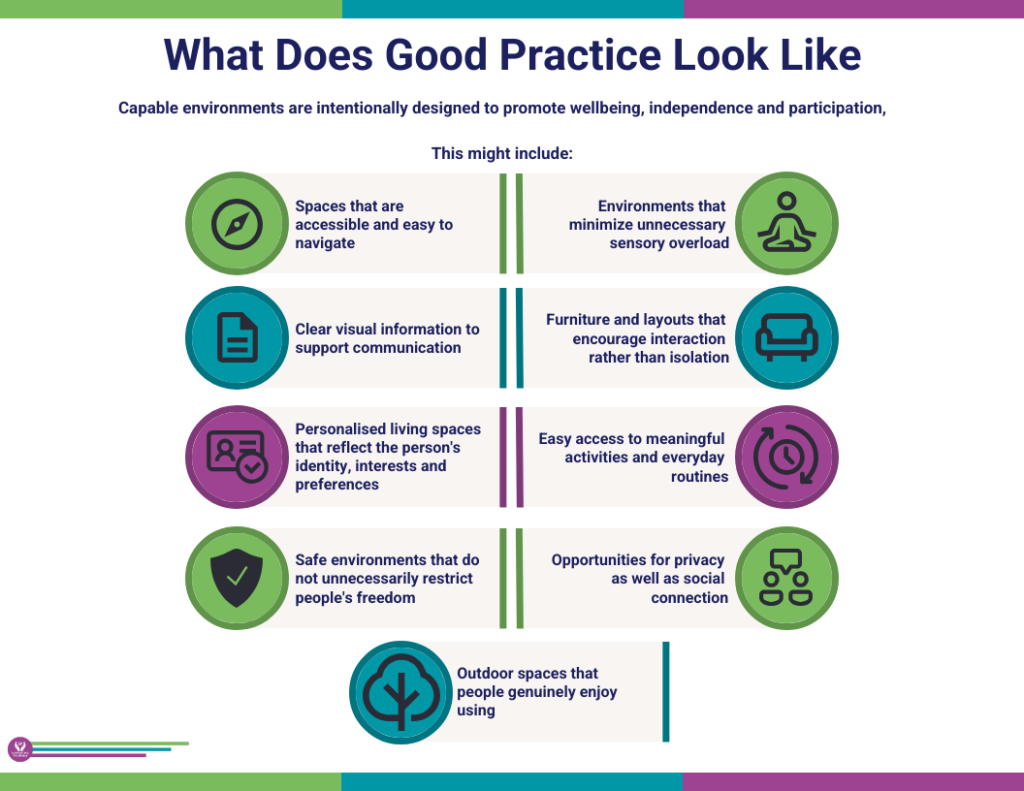
What Does Good Practice Look Like?
Capable environments are intentionally designed to promote wellbeing, independence and participation.
This might include:
- Spaces that are accessible and easy to navigate.
- Environments that minimise unnecessary sensory overload.
- Clear visual information to support communication.
- Furniture and layouts that encourage interaction rather than isolation.
- Personalised living spaces that reflect the person’s identity, interests and preferences.
- Easy access to meaningful activities and everyday routines.
- Safe environments that do not unnecessarily restrict people’s freedom.
- Opportunities for privacy as well as social connection.
- Outdoor spaces that people genuinely enjoy using.
The goal is not to create the perfect building. It is to create an environment that enables people to live meaningful, self-directed lives.
The Small Things Matter
Sometimes the biggest improvements come from surprisingly small changes.
- Moving frequently used items so they are within reach.
- Reducing background noise during meals.
- Creating a quiet sensory space.
- Displaying photographs that reflect important relationships.
- Giving people easy access to the garden whenever they choose.
These changes may seem simple, but together they shape everyday experiences and can significantly improve quality of life.
Questions for Reflection
Take a look around your service with fresh eyes.
Ask yourself:
- Does this environment feel like someone’s home or does it feel like a service?
- What messages does the environment communicate about the people who live here?
- How easy is it for people to make choices independently?
- Are there any environmental barriers that limit participation?
- If you experienced this environment yourself every day, how would it make you feel?
Sometimes the most valuable improvements begin with seeing familiar spaces differently.
Creating More Capable Environments
Within the Capable Environments Framework, the physical environment is not viewed simply as a backdrop, it is recognised as an active contributor to quality of life.
When environments are thoughtfully designed, they reduce unnecessary barriers, promote independence and create opportunities for people to live the lives they choose.
The question is not simply whether an environment is safe or compliant.
The question is whether it enables people to flourish.
Ready to Strengthen Your Service?
At Supporting Positively, we developed the Capable Environments Practical Pathway to help organisations move beyond one-off improvements and create lasting change.
Across 12 months, services work through each domain of the Capable Environments Framework with practical tools, implementation workshops, facilitated discussions and action planning, enabling teams to embed improvements into everyday practice rather than simply completing another audit.
Whether you’re looking to improve one service or transform practice across an organisation, we’d love to help.
📧 Email: hello@supportingpositively.com