Communication is fundamental to almost every aspect of our lives.
It is how we express what we want and don’t want. How we build relationships. How we ask for help. How we make choices, share experiences, disagree, negotiate and influence what happens around us.
Yet when someone communicates differently from the people supporting them, opportunities to do all of these things can become significantly reduced.
Within a capable environment, the question isn’t simply:
“Can this person communicate?”
A much more useful question is:
“Have we created an environment in which this person can communicate successfully and does their communication actually influence what happens?”
Communication Is More Than Speech
When we talk about communication, spoken language can easily become the default.
But people communicate in many different ways.
This might include:
· Speech
· Signs
· Symbols and pictures
· Objects of reference
· Communication devices
· Facial expressions
· Body language
· Gestures
· Changes in behaviour
· Movement towards or away from something
· Vocalisations
· Changes in engagement or emotional presentation
Sometimes communication is obvious. Sometimes it is subtle.
A person turning their head away may be saying “no”.
Someone repeatedly taking a staff member towards a cupboard may be communicating what they want.
A change in someone’s behaviour may be telling us that something is wrong.
The responsibility cannot sit solely with the person to make themselves understood.
A capable environment adapts to the communication needs of the individual.
Being Heard Isn’t the Same as Having Influence
There is an important distinction between giving someone an opportunity to communicate and ensuring their communication actually matters.
Imagine being repeatedly asked:
“What would you like to do today?”
…but the answer rarely changes what happens.
Technically, you have been asked.
You have had an opportunity to communicate.
But have you genuinely had choice or influence?
Communication becomes meaningful when it changes something.
This might mean someone’s “no” is respected.
Their preference changes the plan.
Their discomfort results in action.
Their interests influence what opportunities are created.
Their communication leads the people around them to stop, listen and reconsider.
Being heard matters.
Having influence matters even more.
The Environment Can Create Communication Barriers
Sometimes we describe people as having “communication difficulties” without considering how much of the difficulty is created by the environment around them.
Imagine being supported by people who don’t understand your preferred communication system.
Imagine having a communication device but it isn’t within reach.
Imagine having symbols available, but only staff decide when they are used.
Imagine needing additional processing time but being asked another question before you’ve had time to answer the first.
Or imagine communicating through subtle changes in behaviour while the people around you change frequently and don’t know you well enough to recognise them.
In each of these situations, the person’s communication ability hasn’t necessarily changed.
The environment has made successful communication harder.
That is why communication is such an important component of a capable environment.
What Does Good Communication Support Look Like?
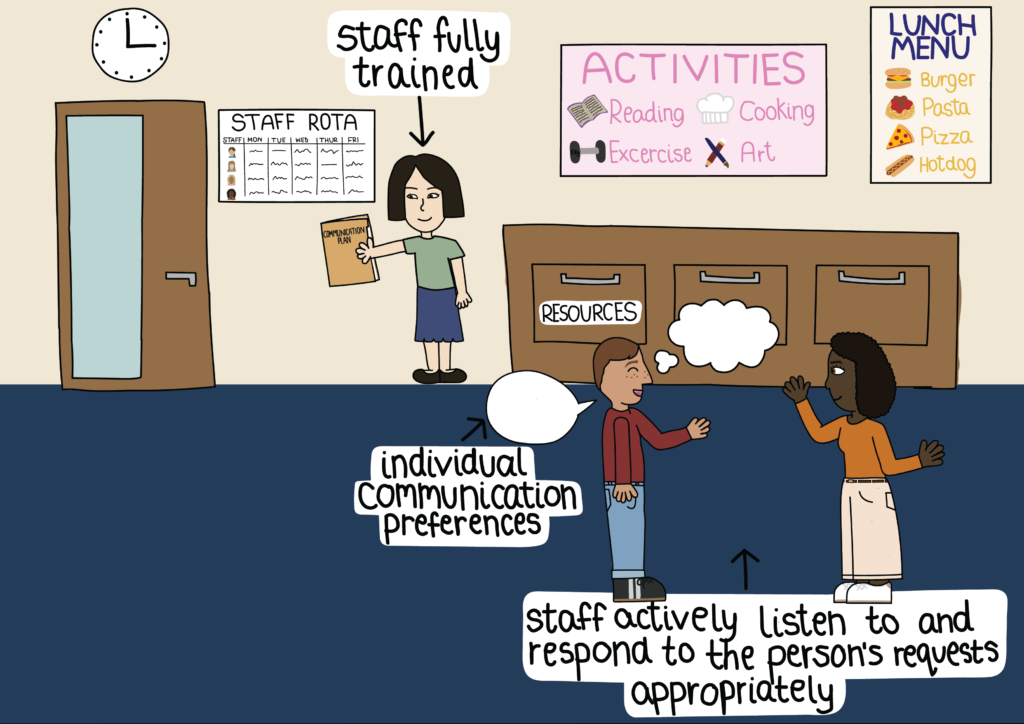
Good communication support should be individualised and embedded within everyday life.
It might include:
· Staff understanding how each person communicates.
· Information being provided in a format the person can understand.
· Communication aids being readily available when they are needed.
· Staff consistently using agreed communication approaches.
· Allowing sufficient processing time.
· Recognising non-verbal and behavioural communication.
· Supporting people to initiate communication rather than only responding to questions.
· Checking understanding rather than assuming it.
· Ensuring communication passports remain current and genuinely reflect the person.
· Working collaboratively with families, Speech and Language Therapists and others who know the person well.
Most importantly, communication support shouldn’t only appear during assessments, reviews or structured activities.
It needs to be part of ordinary life.
Communication and Behaviour
Within Positive Behaviour Support, understanding communication is particularly important.
Behaviour may sometimes be one of the most effective ways available to someone to communicate a need.
“I need a break.”
“This is too difficult.”
“I don’t understand.”
“I don’t want this.”
“I’m in pain.”
“I want your attention.”
“I need more control.”
If we respond only to the behaviour without understanding what the person is communicating, we risk trying to remove an important form of communication without addressing the reason it was needed.
Instead of asking only:
“How do we reduce this behaviour?”
we should also be asking:
“What might this person be telling us — and how can we make it easier for them to communicate this in other ways?”
Communication Is Everyone’s Responsibility
A communication plan can be excellent on paper and still have very little impact on someone’s life.
The real test is what happens on an ordinary Tuesday afternoon.
Do the people supporting the person know how they communicate?
Are communication tools available?
Do staff notice subtle communication?
Do they wait for responses?
Do they respect “no”?
And does what the person communicates actually change what happens next?
Creating a capable communication environment isn’t about having the right documents.
It’s about what happens in thousands of small interactions every day.
Questions for Reflection
Think about someone you support and consider:
· How do they tell you when they are happy?
· How do they tell you they don’t want something?
· How do they communicate discomfort or pain?
· How do they initiate interaction?
· Do all members of the team recognise these signals?
· Are their communication tools available whenever they need them?
· How much time are they given to process information and respond?
· When they communicate a preference, how often does it genuinely influence what happens?
And perhaps the most important question:
Are we asking the person to fit our communication style, or are we adapting our environment to fit theirs?
Creating More Capable Environments
Communication is one of the 12 domains within the Capable Environments Framework because it underpins choice, relationships, independence, participation and quality of life.
When people can understand what is happening around them, communicate what matters to them and influence their lives, we create greater opportunities for autonomy and meaningful participation.
But achieving this requires more than introducing a communication tool or writing a communication passport.
It requires teams to consistently turn good intentions into everyday practice.
Want to Strengthen Capable Environments in Your Service?
Our Capable Environments Practical Pathway supports services to work through all 12 domains of the Capable Environments Framework over 12 months.
Rather than completing an audit and putting it away, teams are supported to identify what is already working, understand where barriers exist and make practical changes that can be embedded into everyday support.
The pathway combines e-learning, practical assessment, facilitated workshops, action planning and ongoing support to help services turn reflection into meaningful change.
If you’d like to explore how the Capable Environments Practical Pathway could work within your service or organisation, get in touch:
hello@supportingpositively.com
Capable Environments Reflection
If someone communicated “no” without using the word no, would everyone supporting them recognise it and would it change what happened next?